






MANUFACTURING
2026/08/28
[Part 2] Nikkiso Vietnam, Inc. is expanding its product range from engine nacelle parts to wing and fuselage components
- Aerospace
- Aircraft
- CFRP
- Interview
![[Part 2] Nikkiso Vietnam, Inc. is expanding its product range from engine nacelle parts to wing and fuselage components](/media/FUvRilkmaaM2sm9uDeXK0jRNEocewdSV4LQNW5BJ.jpg)
Index
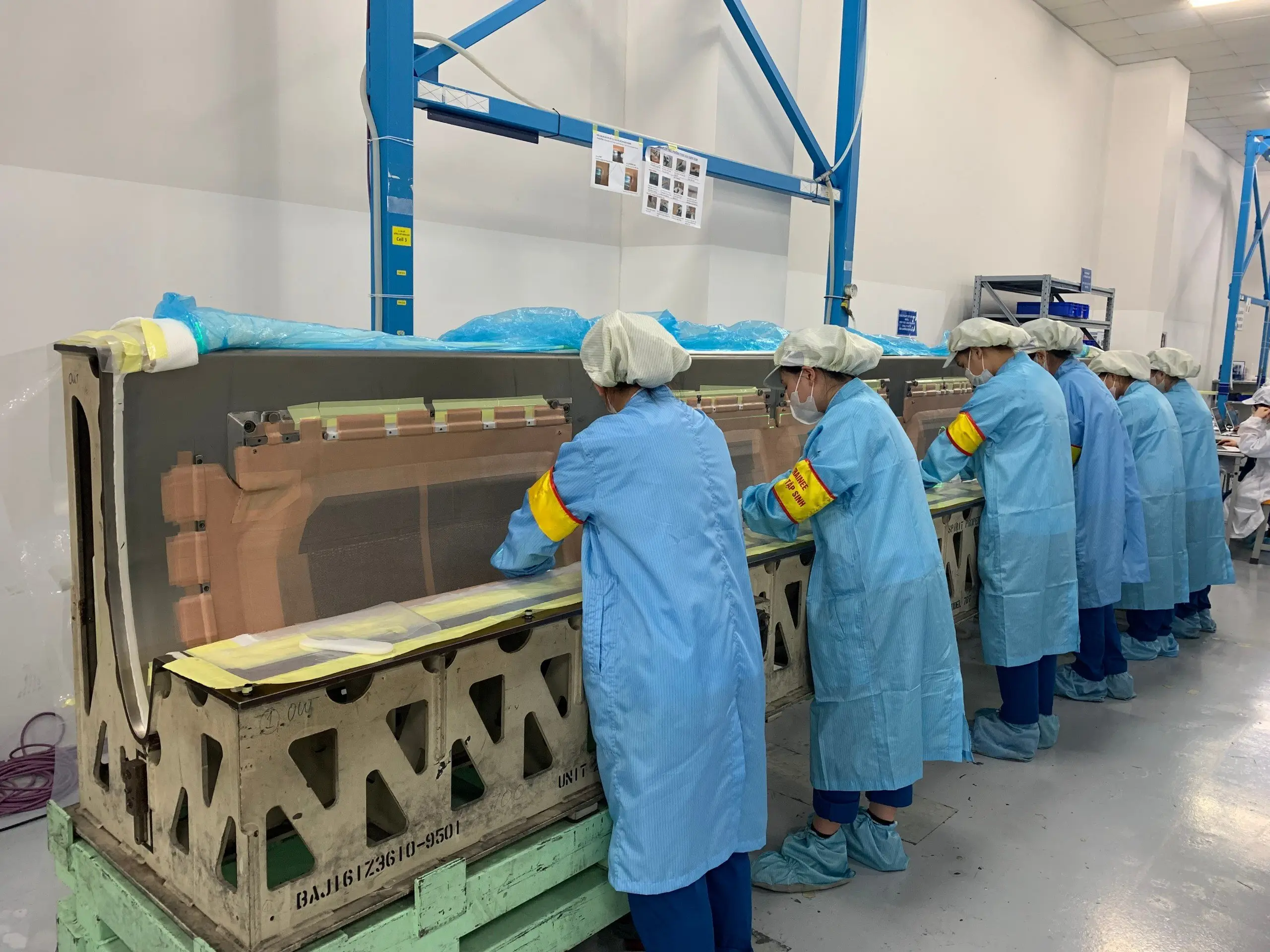
The core product of Nikkiso’s Aerospace Division is cascades for engine thrust reversers. We have been rapidly expanding our product lineup and are now manufacturing a wide range of products from engine nacelle parts to wing and fuselage parts. A driving force behind this expansion has been Nikkiso Vietnam, Inc. (NVI), which operates two factories near Hanoi, Vietnam.
NVI now produces approximately 250 different products. In this two-part series, we explore NVI’s energetic approach to the ongoing challenge of new product development, from both Japanese and Vietnamese perspectives. In the second part, we will hear from Factory Manager Yoshiyuki Waki, Senior Production Manager Nguyen Thanh Nam, Inspection Manager Nguyen Thanh Cong, and Production Control Manager Nguyen Anh Tuan about on-site kaizen activities and initiatives that have made multi-product manufacturing possible.
(Titles and affiliations are as of the time of the interview (July 2024). Yoshiyuki Waki is now General Manager of the Aerospace Research & Technology Center.)
“Another of NVI’s strengths is that we are never satisfied with the status quo and are always engaging in kaizen.”
— As factory manager, how do you feel about the Vietnamese staff working at the site?
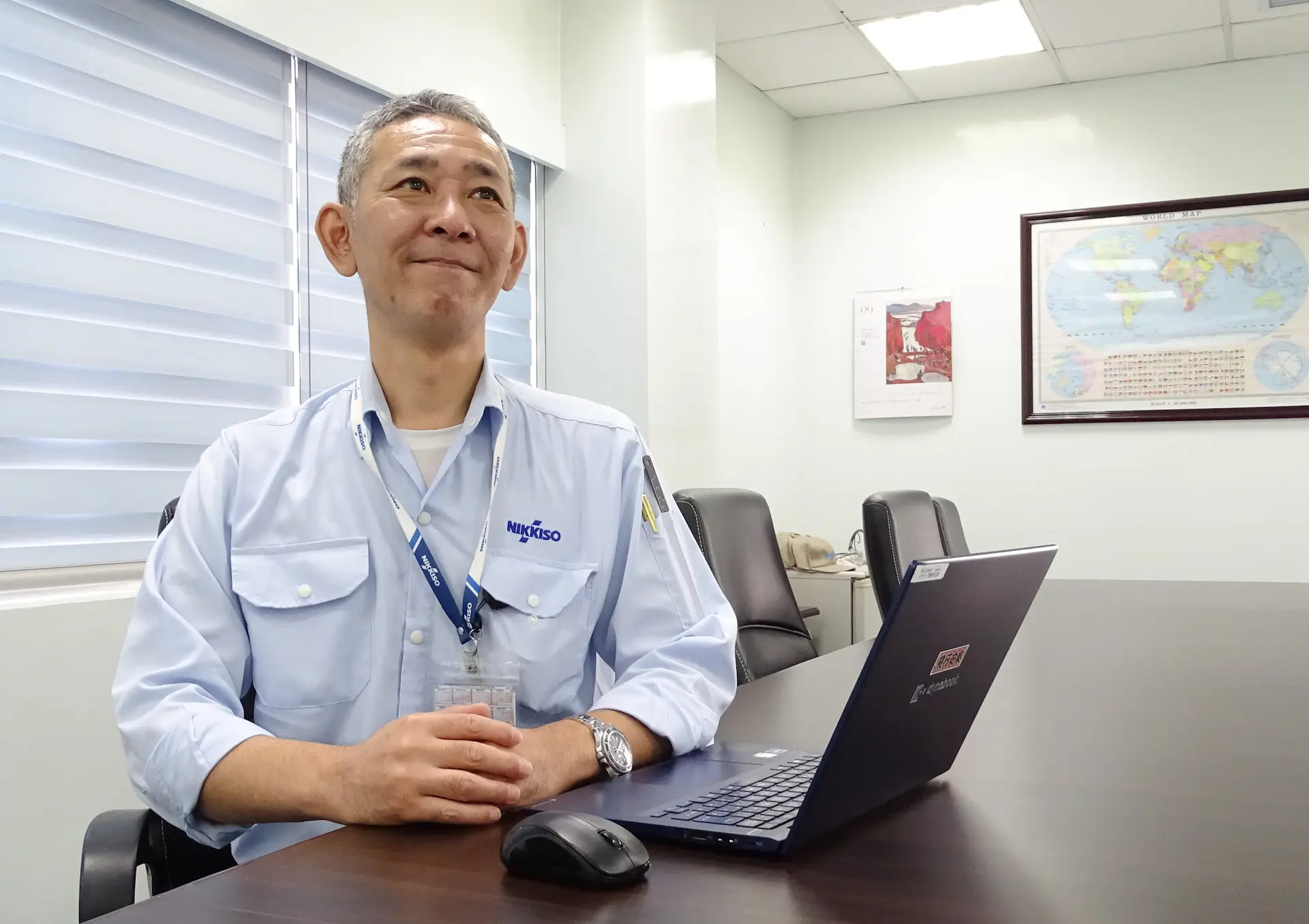
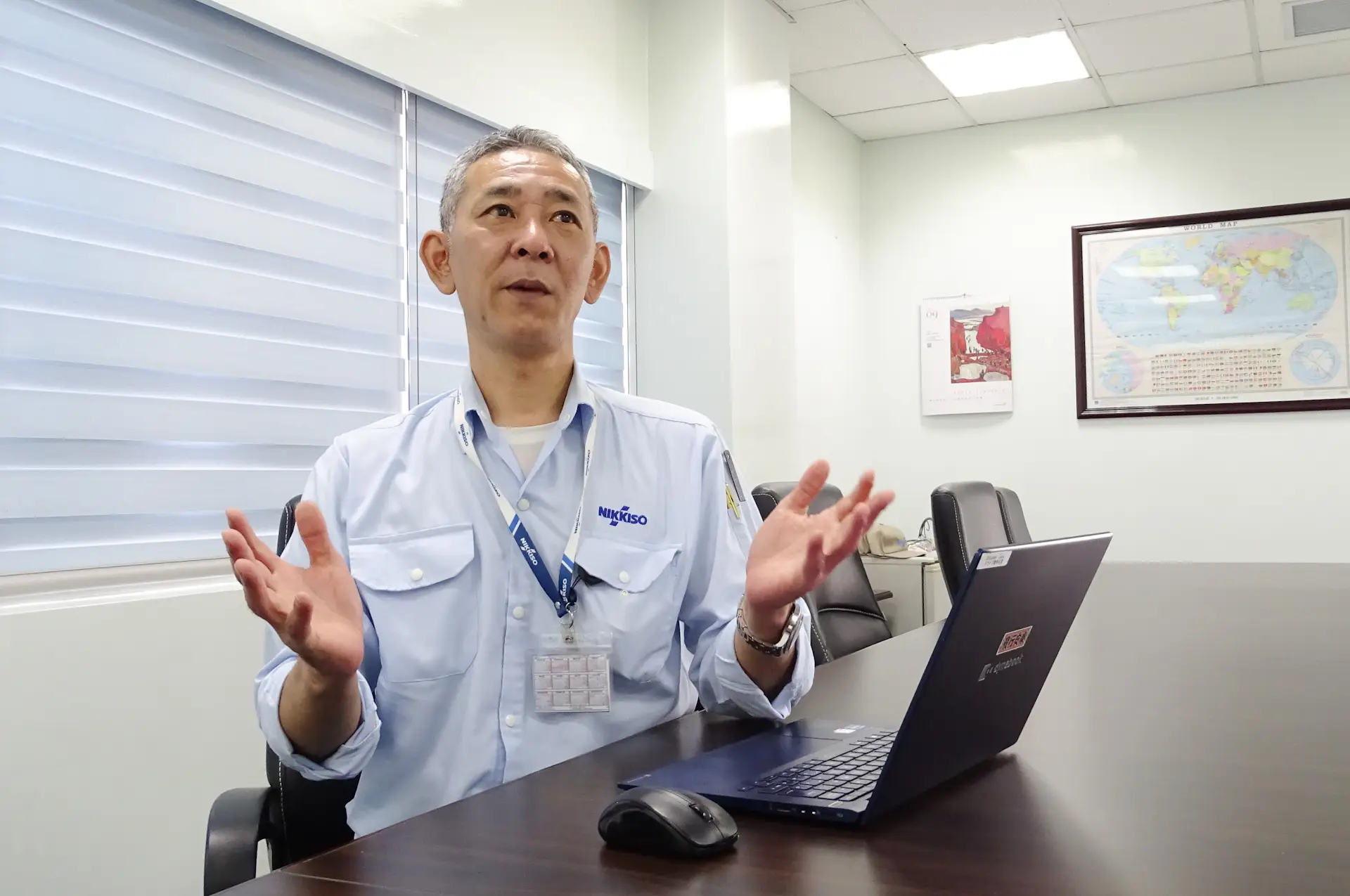 Factory Manager Waki (current General Manager of the Aerospace Research & Technology Center)
Waki: They come to us with ideas from the factory floor, saying, “How about doing it this way?” The “Gemba” capability here is really strong. There are no meetings set up specifically for this purpose, but they carry out kaizen activities* on a daily basis. NVI has a department called “Kaizen” that creates jigs (tools used to manufacture products), improves workflow to increase work efficiency, and the like. When I asked them to make a stand to hold jigs and parts, they made it the next day. The speed is astonishing.
* Kaizen activities: Bottom-up activities in which staff on the manufacturing floor improve the efficiency of operations, jigs, etc., at their own initiative, in order to enhance productivity, safety, and other factors.
Nam: Up to now, we have outsourced the production of jigs, but we have not been able to obtain what we wanted. It takes a lot of time and effort to make drawings, ask for quotes, and write purchase orders. We thought it would be easier to work with our own ideas, so we started making prototypes repeatedly, and the accuracy of our products began to improve. We believe that one of NVI’s strengths is that we are never satisfied with the status quo, but constantly engage in kaizen.
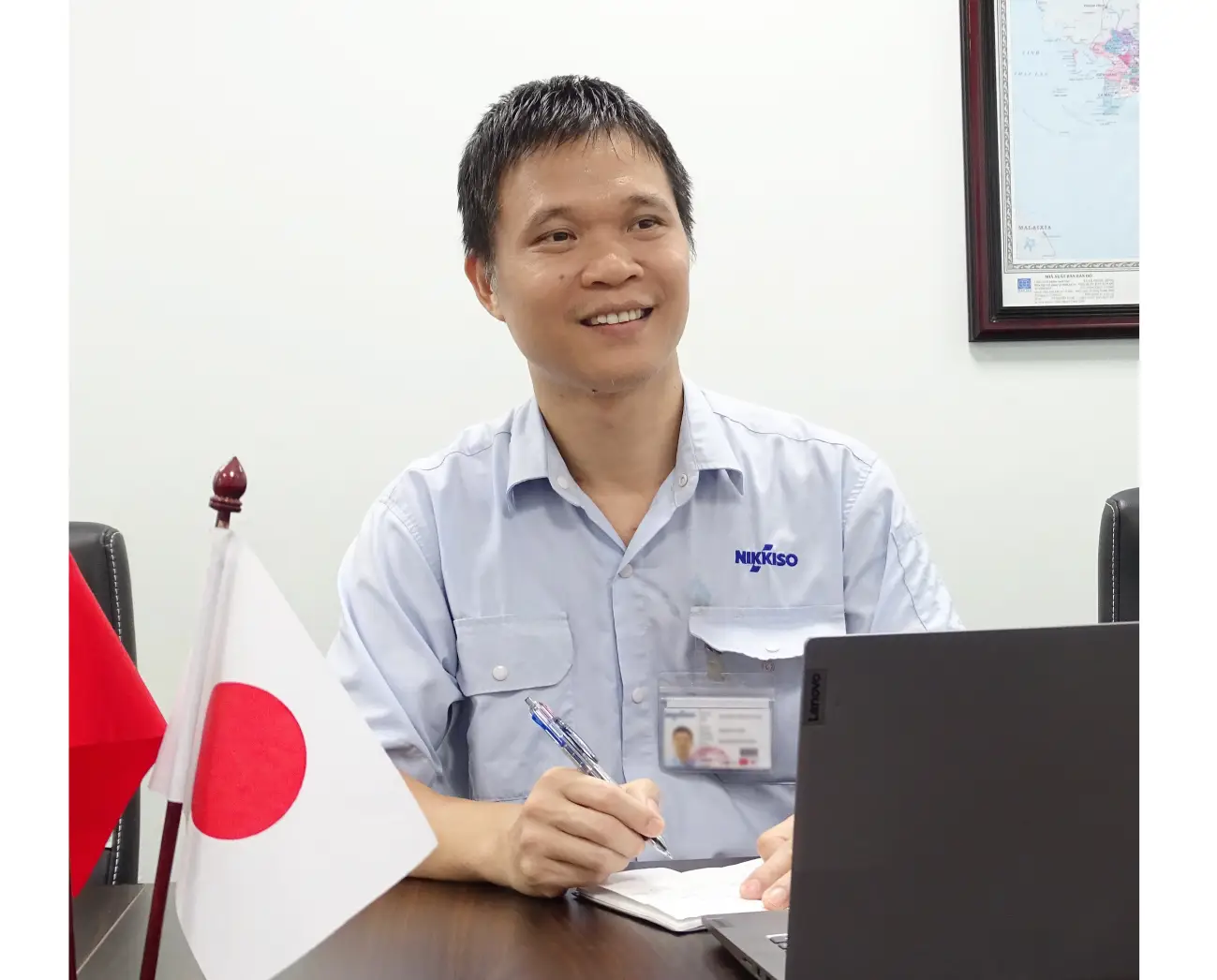 Senior Production Manager Nam
Waki: NVI is developing quite a large number of products simultaneously, so we encounter the need for jigs and work tools suitable for the products we are developing almost every day. Therefore, the agility for kaizen activities is tremendous.
— What are the aims in having Vietnamese staff join the management team?
Waki: There is no special intention behind this. The idea is to simply place talented people in appropriate positions.
It has been 15 years since NVI began mass production, and Nam, for example, has been working for us for 14 years. Nam has a wealth of expertise in workflow management and manufacturing, as he worked in production engineering in his previous job and started out on the manufacturing floor at NVI. It would be natural to ask such a highly capable person to hold an important position.
Having Vietnamese managers also allows for a more nuanced understanding of the concerns of their subordinates. If the person is capable, we would like to move toward a system where department managers are local Vietnamese staff.
— As factory manager, is there anything you're conscious of when working together with Vietnamese staff?
Waki: It is about responding as much as possible to what Vietnamese employees are seeking.
For example, company trips are very popular in Vietnam. NVI has about 940 employees, and 500–600 people always participate. We charter 10 or more buses for these trips. Currently, the trip is for two days and one night, but the labor union has requested that it be extended to two nights. That’s how popular they are.
In Japan, company trips are considered to be a thing of the past, but in Vietnam, everyone who works for a company is considered family, so everyone wants to participate. I want to respect that sensibility and take it seriously. This year, we couldn’t secure the budget, so it remains a two-day, one-night trip... (laughs)
“Discussions for kaizen are conducted spontaneously on site”
— I would like to ask the three Vietnamese managers about their duties again. First of all, how about you, Mr. Nam?
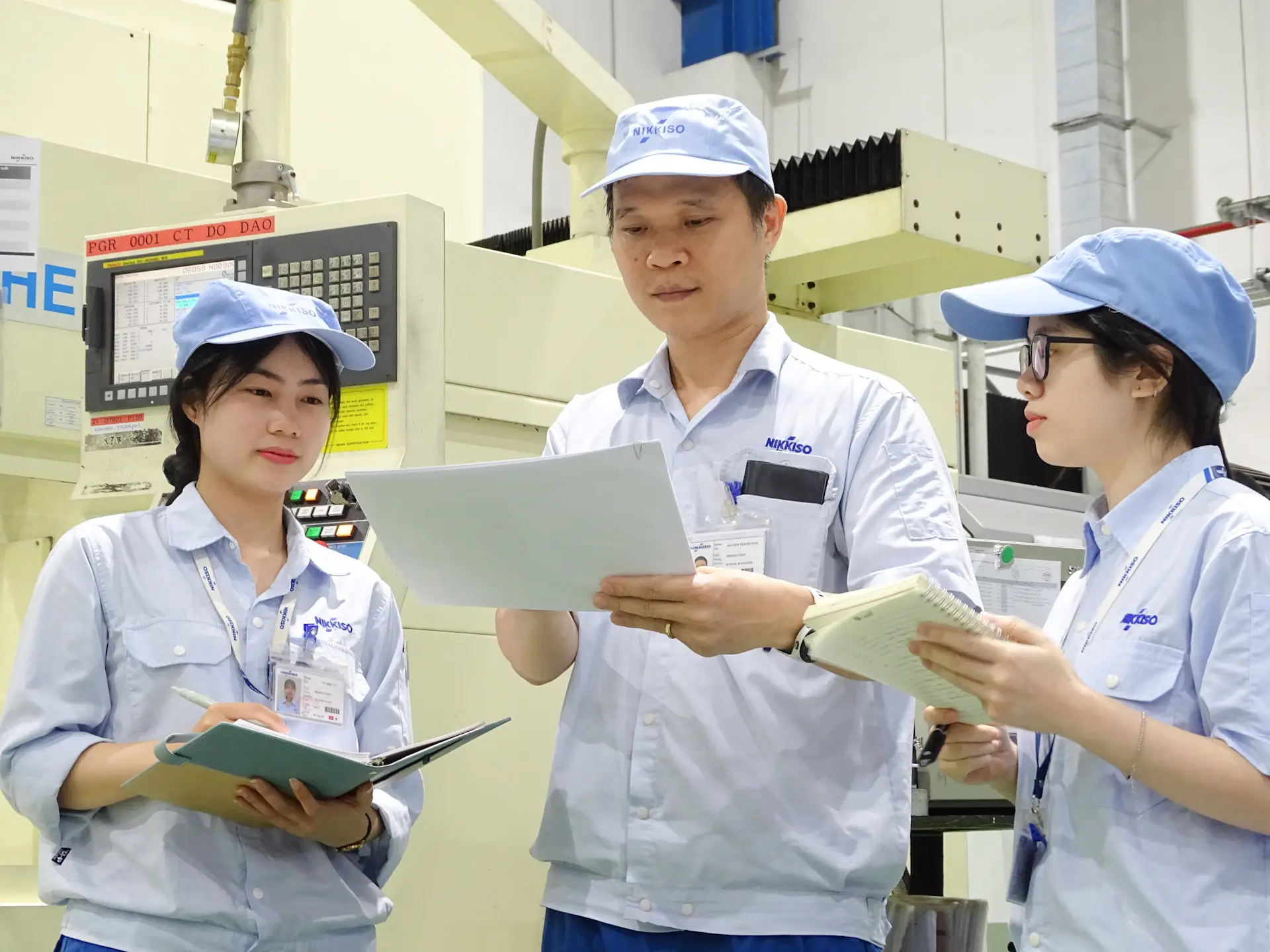
Nam: I am a senior manufacturing manager who oversees a combined manufacturing staff of about 500 people at the first and second factories. While observing the workplace, I provide guidance on improving manufacturing efficiency and provide instructions on how to handle problems. When I provide guidance while showing causes and countermeasures, the staff spontaneously engages in kaizen activities, and the atmosphere is that everyone enjoys their work.
— How do you train your staff to manufacture a wide variety of products?
Nam: The specifications required by aircraft manufacturers are complex, so I first show the staff how to interpret them. Once I have shown them that, the staff members can read and understand the specifications correctly and spontaneously engage in discussions on site for better kaizen. This can then be horizontally expanded to other products.
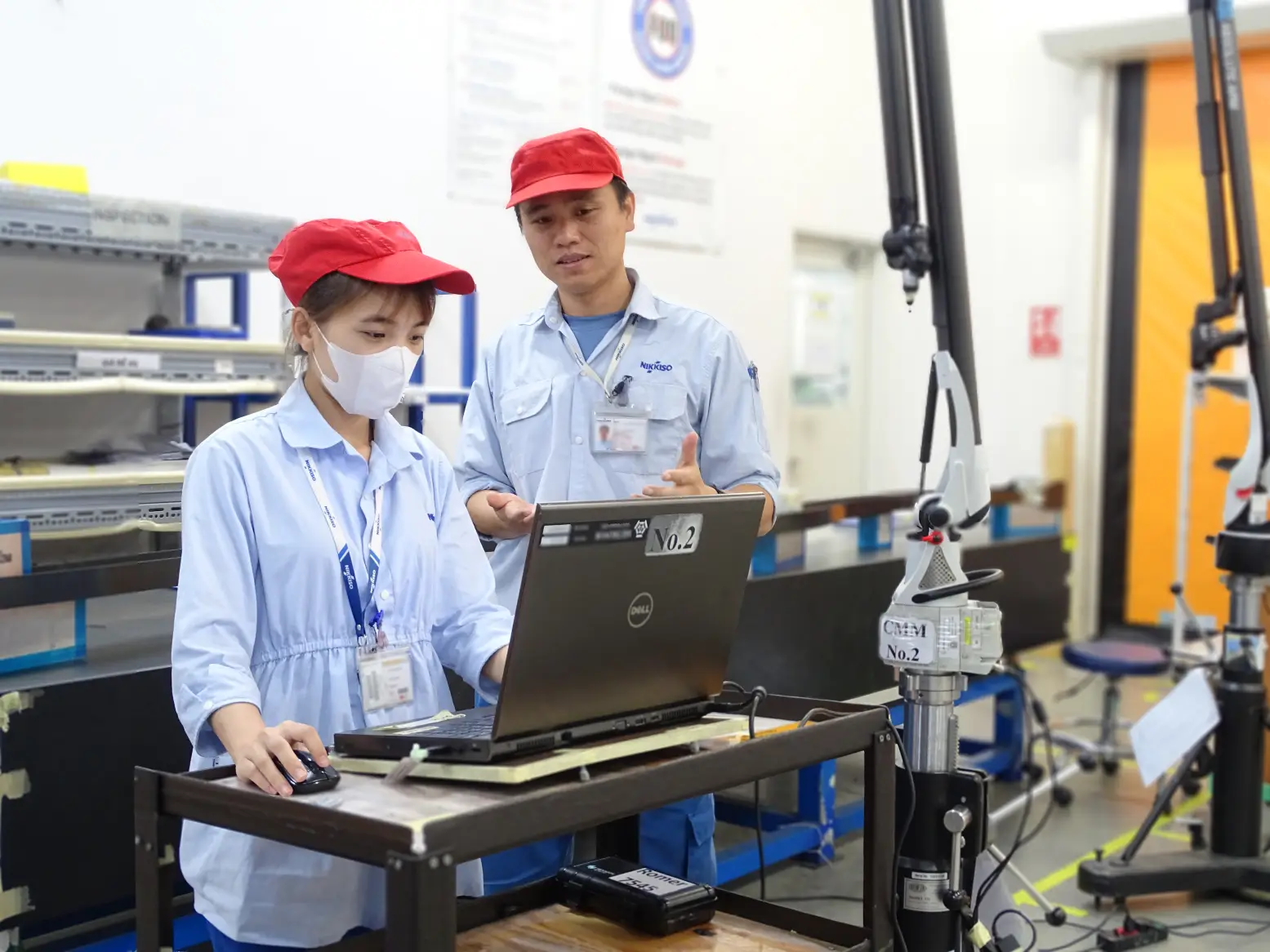
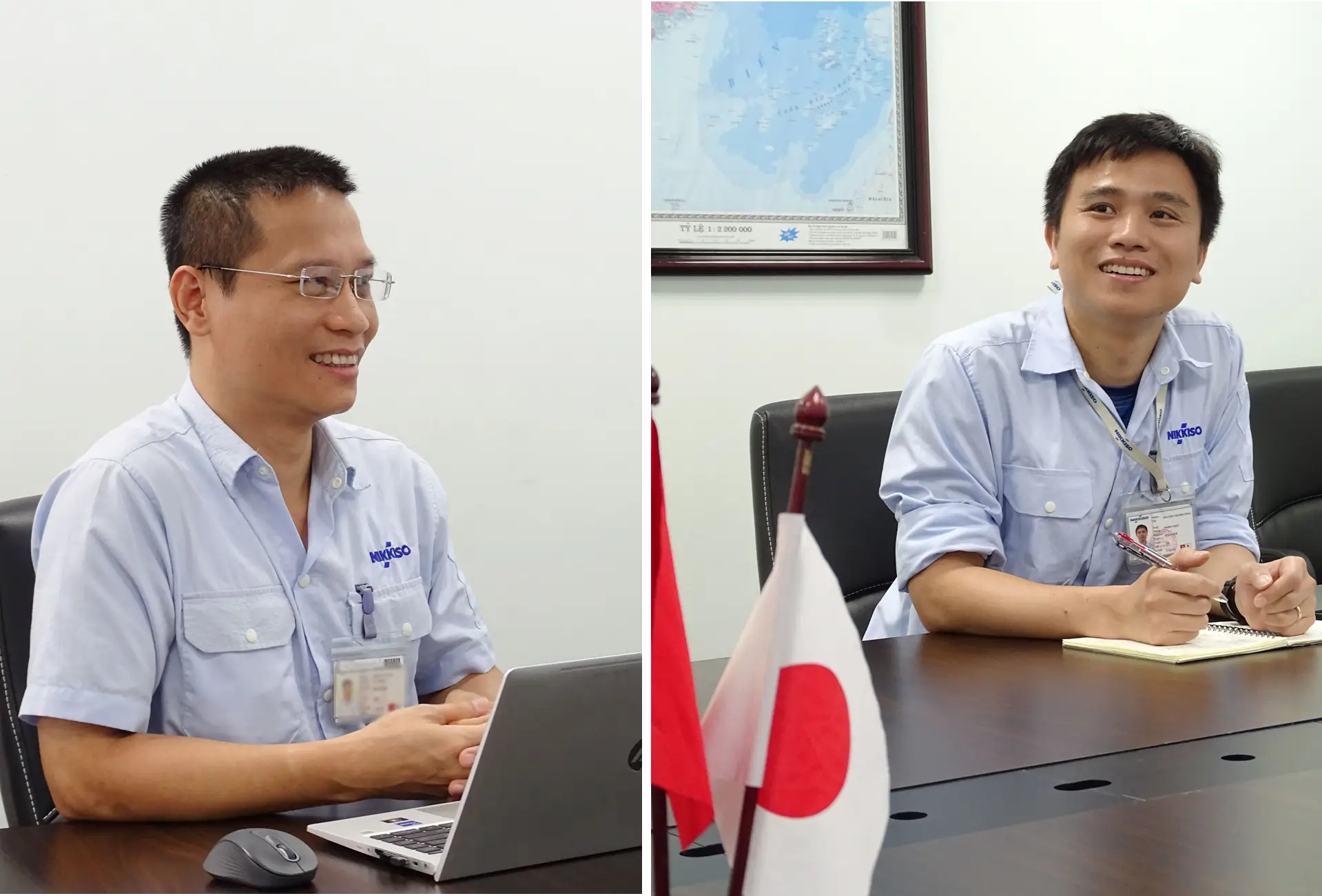 Production Control Manager Tuan (left) and Inspection Manager Cong (right)
— What is the work that you are in charge of, Mr. Cong?
Cong: I am an inspection manager and I have about 200 people under me.
There are three main categories of operations. The first is acceptance inspections. We check that materials sent from suppliers are correct and have no quality problems. The second is in-process inspections. During the manufacturing process, we check to make sure that manufacturing is being done correctly. The third is final inspections. As the last line of defense before shipping to the customer, we verify and document that all product requirements have been satisfied.
— At NVI, where as many as 250 products are manufactured, inspection must be a challenge!
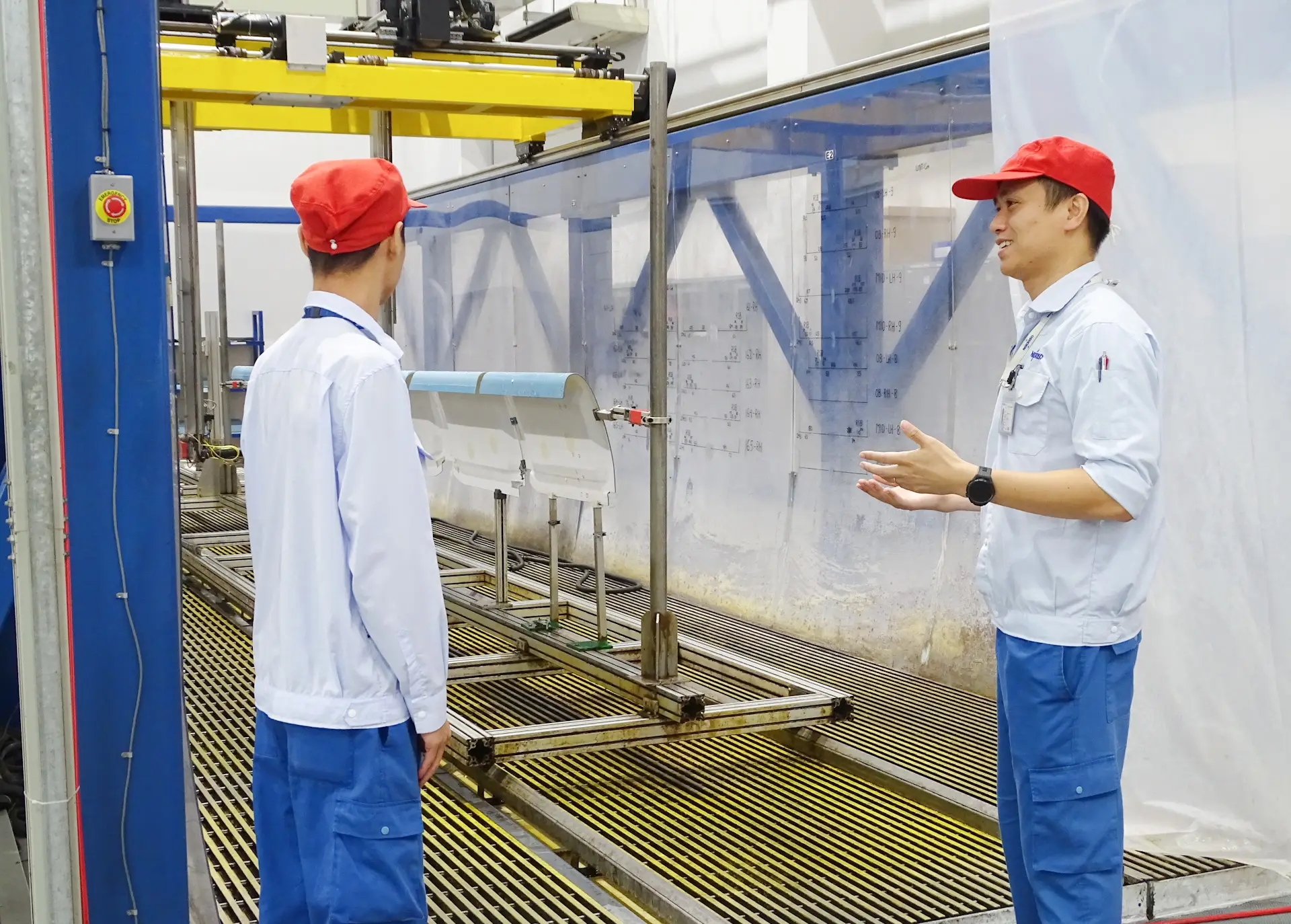
Cong: Different customers have different product requirements. Therefore, each inspector must be familiar with the requirements of the products for which they are responsible and inspect them correctly.
Since many of the specifications are written in English, inspectors who only understand Vietnamese must be especially well trained. Therefore, we prepare documents in Vietnamese based on customer requirements and have them undergo approximately 6 months of education and training before they can inspect products. In education and training, after the trainee has understood the common matters for any product, on-the-job training is conducted on site. Then, they must pass a certification test before finally being certified as inspectors.
Waki: The Vietnamese staff are all very diligent. If you document what needs to be done and educate them well, they will do it quite appropriately. Conversely, it is important to build that mechanism. Once that is done, as a manager, it is enough to check periodically to see if the work is being carried out.
— What kind of work do you do, Mr. Tuan?
Tuan: I am the production control manager and I have 15 subordinates.
There are three main categories of operations. The first is the development of production plans and inventory plans. These determine how the factory operates, and also lead to plans for ordering materials. The second is checking customer demand, which is updated daily, and modifying inventory plans accordingly.
The third is analyzing NVI’s production capacity and verifying resources. If a customer suddenly asks for a large number of products, we cannot respond if we do not have enough equipment, jigs, or personnel. One of our important tasks is to analyze how much product we can produce.
For example, if an order is placed to deliver 10 units of a certain product in two months, when do we need to start making it, how much inventory do we need in case something goes wrong, when do we need to order materials, and is this realistic? I examine all of those points.
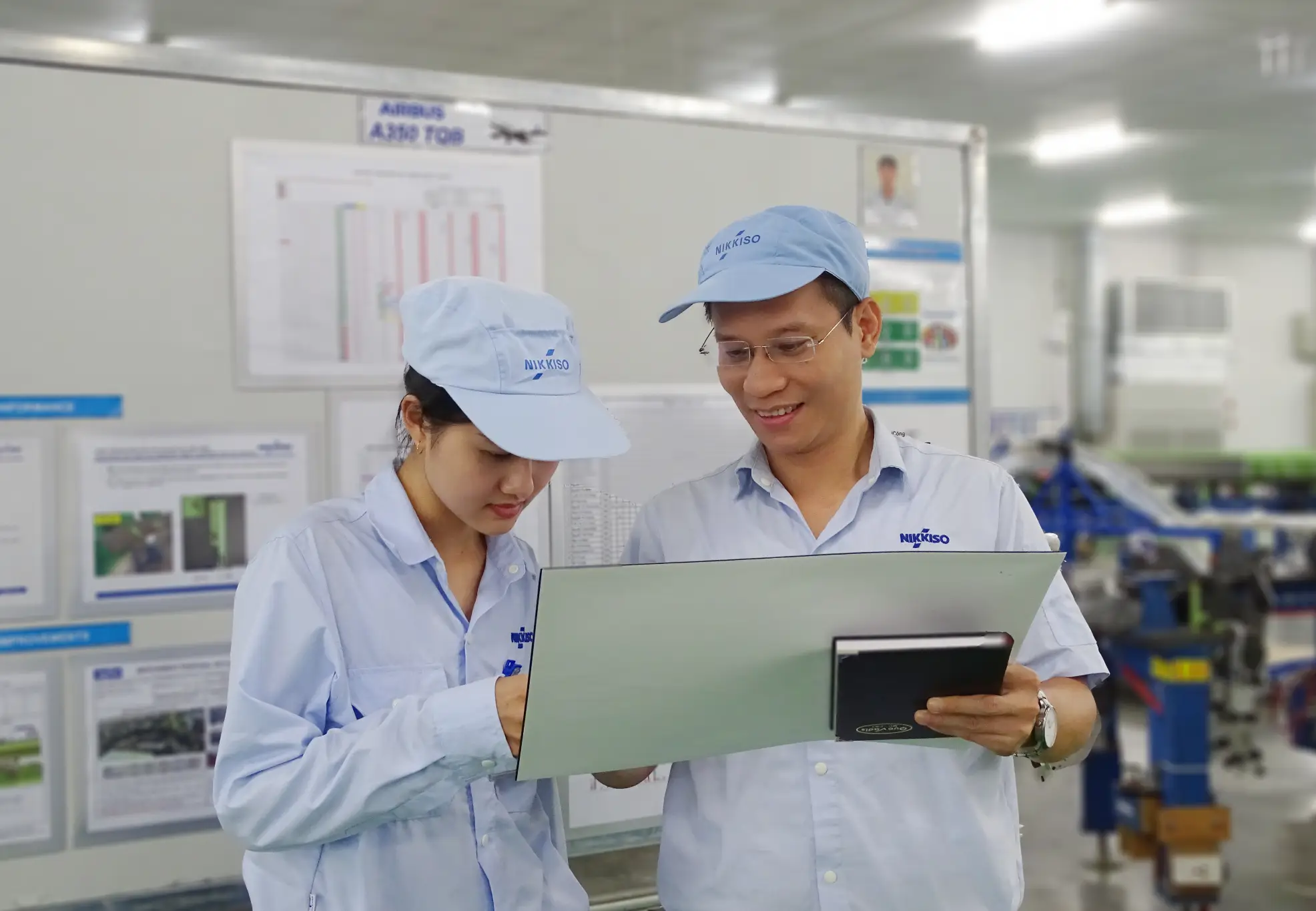
— Isn’t it difficult to make a production plan when many items are being manufactured at the same time?
Tuan: Products are assigned to specific people, for example, the Boeing program and the Airbus program, so that nothing is overlooked.
The difficulty arises when the quantity of product demanded by a customer suddenly changes. Overtime work may be required, and materials must be ordered and received in a hurry. The COVID-19 pandemic, which saw a sharp decline in aviation industry demand, caused the opposite problem. Suddenly we were being told by customers that they didn’t need the products. However, it would be bad for work to run out altogether, so we slowed down the speed of production planning and reassigned personnel so as not to create a “no work” situation.
— How do you make a production plan?
Tuan: It’s both experience and data. The base is NVI’s accumulated experience. At the same time, we hold a capacity meeting every month, where the actual time taken for each process is collected from each department. The production plan is adjusted in light of both experience and actual data.
“We aim to be the number one composites factory in Asia.”
— Now, finally, please tell us what you would like to work on in the future.
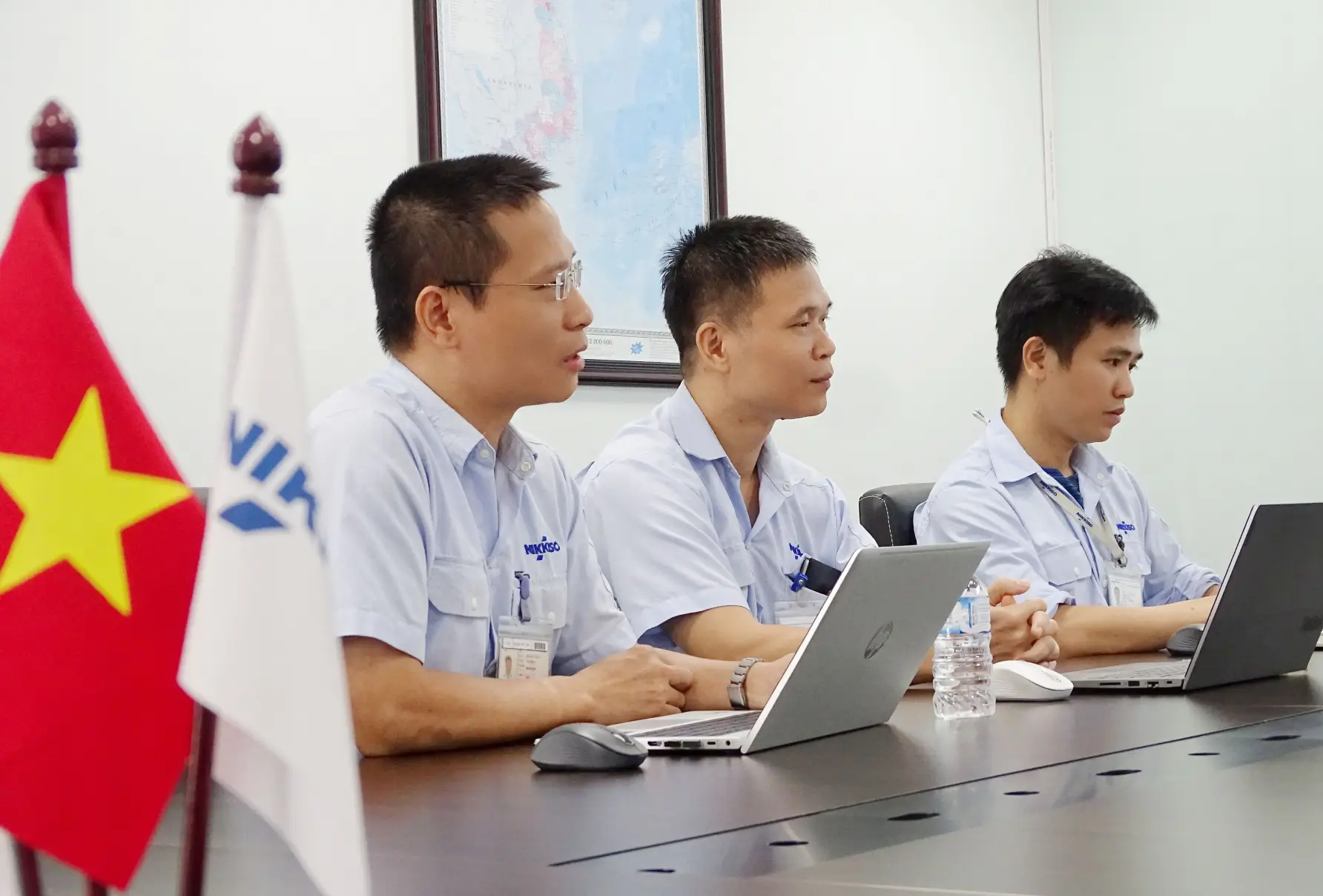
Nam: Up to now, we have relied on the development department or Nikkiso Japan to interpret specifications. I feel that spreading this knowledge down to the staff on the factory floor has reduced the number of nonconformities and problems. I would like to continue to raise the level of manufacturing at both our first and second factories through horizontal development of kaizen activities, thereby increasing orders from customers and growing NVI into an even larger company.
Cong: NVI is growing and must continue to grow. To achieve this, it is necessary to improve the inspection skills of inspectors. In the past, documents such as inspection procedures were prepared by Nikkiso Japan. Recently, however, NVI has been preparing its own documentation and carrying out education in order to gain a deeper understanding of customer requirements.
Tuan: NVI will continue to win more orders and grow. To achieve this, it is necessary to raise the level of staff competence. I believe it is important to be able to anticipate the risks associated with change, especially when tackling something new. To this end, we discuss the progress of the production plan and risks with the relevant departments every day, and we encourage them to express their own ideas and think for themselves in the process.
— Lastly, I would like to ask Factory Manager Waki about NVI’s goals for the future.
Waki: NVI is currently the number one composites factory for aerospace products, at least in Vietnam. However, as a future goal, I would like us to raise our sights so that we can say that we are number one in Asia.
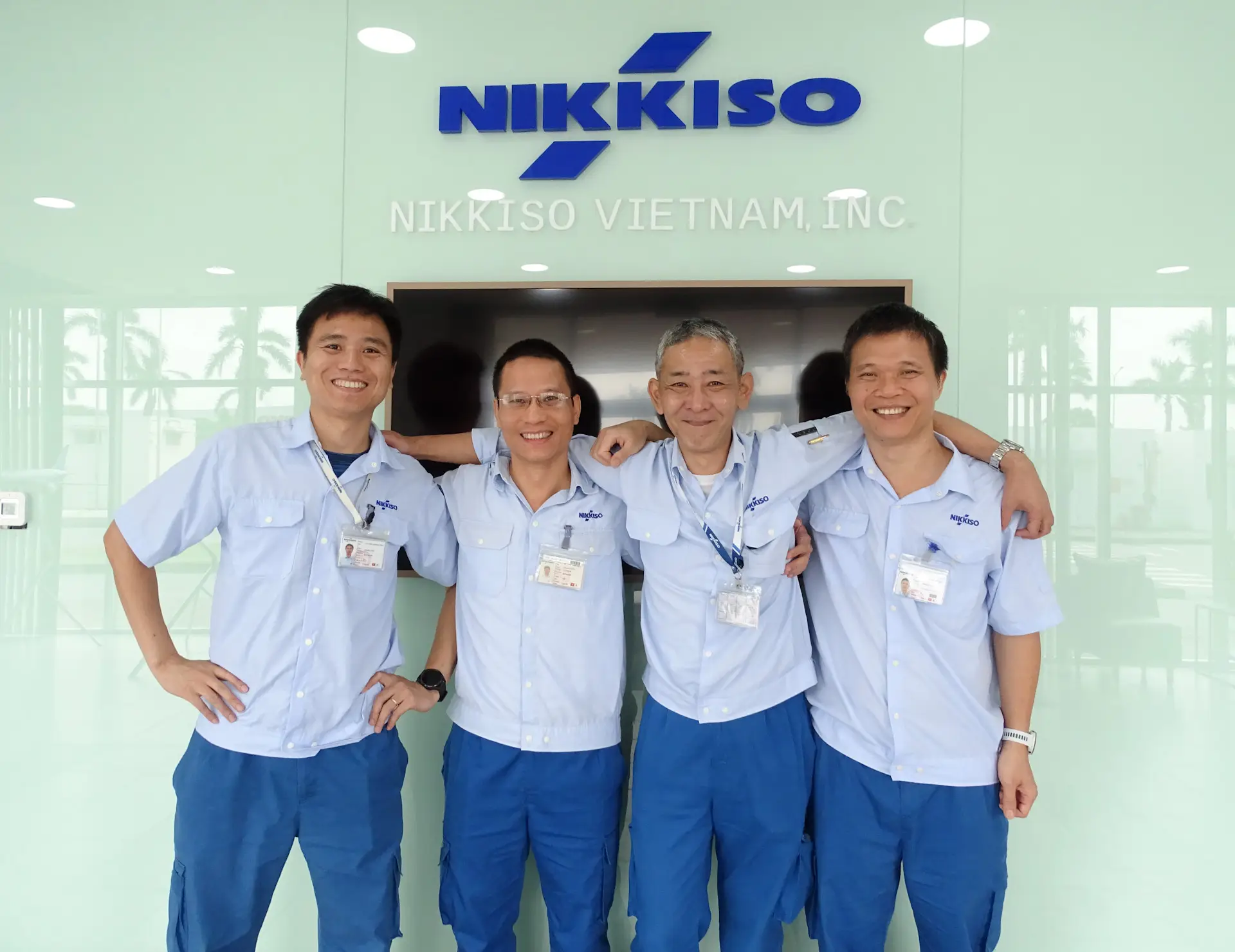
China and Malaysia are now strong in the aerospace composites sector. However, I believe that Vietnam will become more active in the future because of the global desire to avoid the risks that China poses. So for NVI to win out, we must aim to be the “number one composites factory in Asia”.
— What will it take to become “number one in Asia”?
Waki: First of all, it will take people. I believe that personnel training is necessary. The second thing is quality. Delivering good quality products to our customers and ensuring their satisfaction. The third thing is to strengthen our development capability. As new air mobility technologies such as eVTOL emerge in the future, we must not only continue to provide high-quality products, but also be flexible enough to respond to changing customer requirements. At present, we often rely on Nikkiso in Japan for our development work. While maintaining close coordination with them, we would like to build development capabilities within NVI as well.
In 2027, a new research building will be completed at the Nikkiso Institute of Research and Technology (Higashimurayama, Tokyo), further accelerating research and development. From a design perspective, the institute generates ideas such as, “if we do it this way, we can reduce weight more”, or “we can improve reliability more.” NVI will quickly put these ideas to practical use, adding further value from the perspective of manufacturing to propose them to customers. We believe that such a cycle would be ideal.
“If you leave it to them, they will continue to perform kaizen and make things better.” I want us to be that kind of trusted supplier.
この記事をシェアする



Pickup
-
 MANUFACTURING
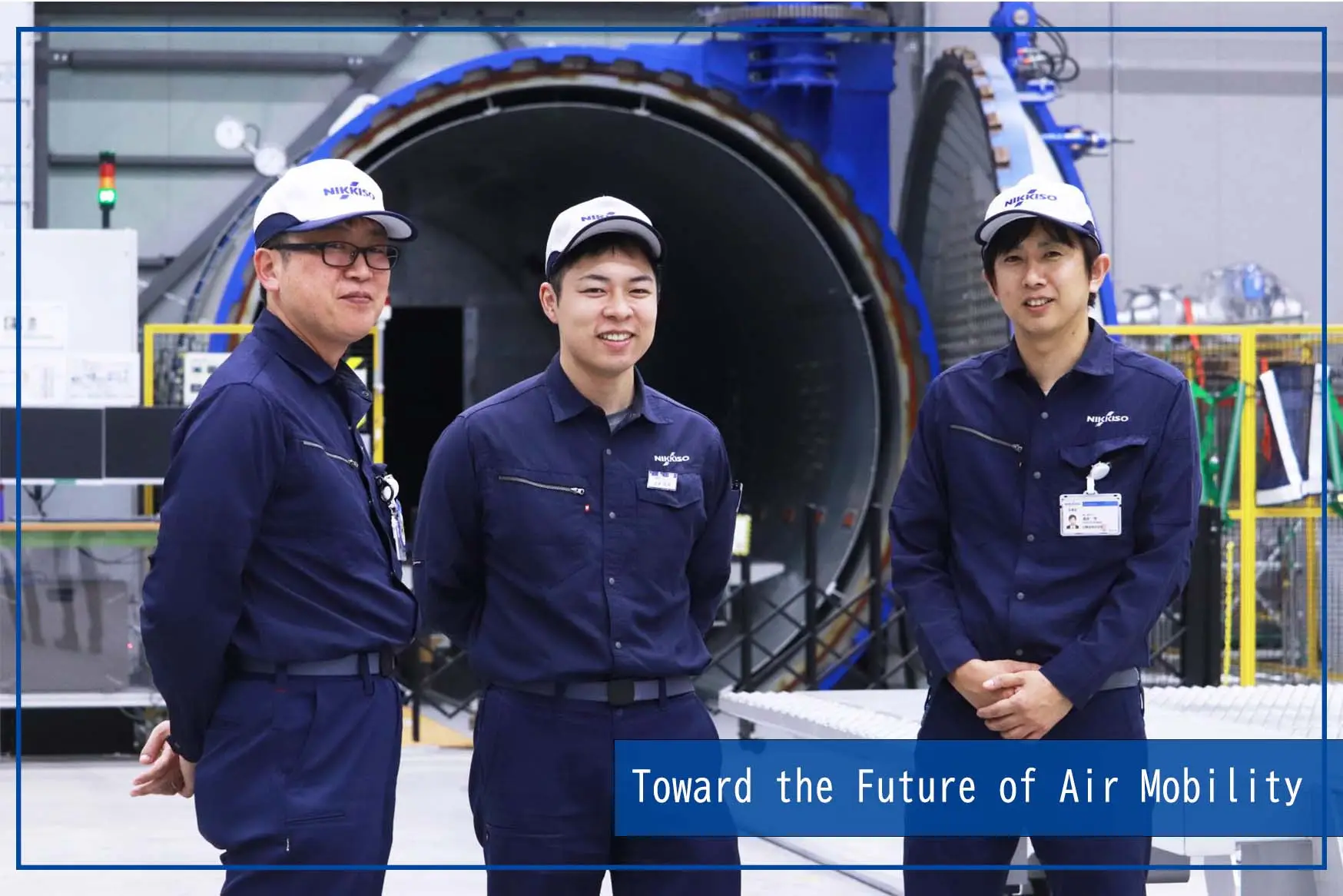
From Cascades, an area where Nikkiso has a global share of over 90%, to eVTOL components. The Nikkiso Miyazaki Aerospace Factory’s insatiable quest for air mobility
- Aerospace
- eVTOL
- Miyazaki
- CFRP
- Interview
- Aircraft
2026/09/10
-
![[Part 1] Nikkiso Vietnam, Inc. is expanding its product range from engine nacelle parts to wing and fuselage components](/media/AVpbAdwaYtg0TEFKF4kBsPQdrX3E7sbCU8GYJkq4.jpg) MANUFACTURING
MANUFACTURING
[Part 1] Nikkiso Vietnam, Inc. is expanding its product range from engine nacelle parts to wing and fuselage components
- Aerospace
- CFRP
- Interview
- Aircraft
2026/08/27
-
 MEDICAL FIELD
What is Green Dialysis? Achieving Sustainable Dialysis Treatment through Industry-Academia Collaboration
- Hemodialysis
- Interview
- Medicalbusiness
2026/08/25
関連記事
-
MANUFACTURING
From Cascades, an area where Nikkiso has a global share of over 90%, to eVTOL components. The Nikkiso Miyazaki Aerospace Factory’s insatiable quest for air mobility
- Aerospace
- eVTOL
- Miyazaki
- CFRP
- Interview
- Aircraft
2026/09/10
-
MANUFACTURING
[Part 1] Nikkiso Vietnam, Inc. is expanding its product range from engine nacelle parts to wing and fuselage components
- Aerospace
- CFRP
- Interview
- Aircraft
2026/08/27
-
 MANUFACTURING
Pumps also actively used in semiconductor manufacturing: 20 years of history of compact, high-speed canned motor pumps
- Technology
- Interview
- Pump
- Semiconductor
2025/05/21
-
 MANUFACTURING
Nikkiso's DX initiatives: CAE Support Department continues to evolve, aiming to eliminate dependence on the skills and expertise of specific people
- Technology
- Interview
2025/04/09
PICK UP
-
From Cascades, an area where Nikkiso has a global share of over 90%, to eVTOL components. The Nikkiso Miyazaki Aerospace Factory’s insatiable quest for air mobility
-
[Part 2] Nikkiso Vietnam, Inc. is expanding its product range from engine nacelle parts to wing and fuselage components
-
[Part 1] Nikkiso Vietnam, Inc. is expanding its product range from engine nacelle parts to wing and fuselage components
-
What is Green Dialysis? Achieving Sustainable Dialysis Treatment through Industry-Academia Collaboration
-
Empowering Asia’s Expanding Dialysis Treatment with Nikkiso’s Advanced Technology and Comprehensive Support